The training workshop for WHRDs from West Nile region on off-line and online safety guidelines was conducted on the 16th and 17th February 2023 at the Satellite hotel Nebbi district in West Nile. The workshop was supported by the French Embassy- in Uganda in partnership with Women Human Rights Defenders Network Uganda (WHRDN-U). The 2 day workshop consisted of 22 participants from across the West Nile region, involved in the defense of human rights and were trained by a team from the WHRDN-U secretariat.
WHRDS in a session during the training
To this end, the training focused on physical security, personal security, information security, office & home security and digital security. Participants discussed some practical measures some of which they already take to minimize security risks and learned about others that they might not have been aware of yet. Participants committed to use the following measures and deal with specific threats in the future for their security and safety:
Create and maintain secure passwords to protect sensitive files on your computer, protect computers from malware and hackers, backing information
Introduce a security registration book for visitors at office
The different physical and digital strategies for personal and organizational protection of WHRDs.
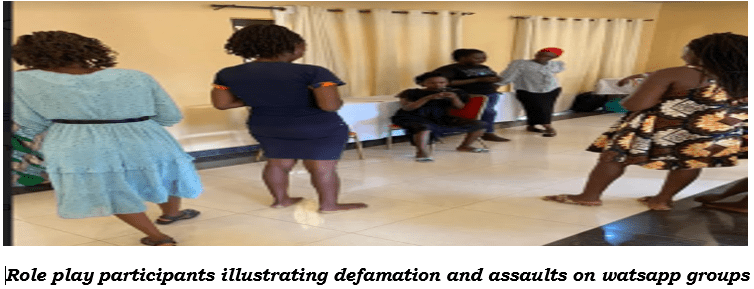
The workshop used interactive activities to help people understand the information, and take part in discussions. For instance; in role plays participants acted out a situation, in small group discussions. Similarly, participants composed a song to help them focus their attention and to make it easy for them to remember the things they learned.
This training workshop was implemented on the basis of the off-line and on-line safety guidelines of WHRDs launched by the UNWOMEN, UNOHCR and WHRDN-U in 2021. The aim of the workshop was to strengthen the capacity of WHRDs and mitigate the impact of online and offline attacks against WHRDs, provide knowledge on mitigating gender-based attacks, criminalization of their work, as well as physical and personal security management, offer practical strategies for enhancing WHRD’s safety online & offline as well as provide WHRDS with basic safety tools for WHRDs in preventing and responding to attacks against them.
Upon this background, WHRDNU with support from the French Embassy of Uganda, conducted workshop to 20 WHRDs from Karamoja region. The training was conducted on 3rd and 4th November,2022, at Seven ranges hotel, in Moroto district. The two day activity was organized to strengthen the capacity of WHRDs and mitigate the impact of online and offline attacks against WHRDs, provide knowledge on preventing and mitigating gender-based attacks, criminalization of their work, as well as physical and personal security management, offer practical strategies for enhancing WHRD’s safety online & offline as well as provide WHRDS with basic safety tools for WHRDs in preventing and responding to attacks against them.
Capacity building training
Remarks from WHRDN-U Secretariat
Ms. Brenda Kugonza of the WHRDN-U started by appreciating the French Embassy in Uganda noting that without their financial support, the training would not have happened. She thanked WHRDs for the good work they do to defend rights in Karamoja region and welcomed them to the training. Brenda then gave details on the objectives of training. She said that training workshop is to increase the knowledge and skills of the participants and their organizations the in relation to off-line and on-line safety guidelines. It would facilitate the spread of information, skills, and culture to prevent and respond to attacks, threats and risks both on-line and off-line by WHRDs. Training workshop was an opportunity to strengthen the capacity of Karamoja WHRDs because they had participated in developing the guidelines during a workshop that was conducted by UNWOMEN, UNOHCHR and WHRDN-U .
Remarks from the district representative
Ms. Betty Nakiru, a female police officer working with Moroto District Child and Family Protection Unit, in her remarks appreciated the WHRDN-U for supporting the work of WHRDS in Karamoja region. She urged participants to report to police when attacked for supporting girls and women the community. If also us the police women are attacked for supporting survivors of domestic violence and what about you. she noted that if women defenders are attacked, then the marginalized people suffer. She ended her remarks by urging them to get her contacts.
Role plays. Types of violence against WHRDs
Joan Namulondo of WHRDN-U, employed the role play methodology f in this session to further help participants understand the concepts. Four (4) scenarios (See below) were role played by participants to identify the online and offline, attacks, and gender-based attacks faced by WHRDs in their region. Reflections and learnings scenarios included:
Human rights work is risky and the need to prepare to deal with un expected risks, threats, and security incidents.
Human Rights activities cannot be successful without security measures.
WHRDs in Karamoja, have suffered the same risks such as those roles played
DAY 2
Digital and social media security management
The purpose of the session was to learn about Digital and Online Security Management. The learnings were imparted when participants mentioned that digital security in relation to smart phones, mobile phones, internet café, phones, cameras, modems, flash discs, emails, watsapp, Facebook, Twitter, Instagram, Tiktok etc. Through a brain storming session, participants learnt some basic computer security measures such as to install antivirus to protect their computers from malware and hackers, to create and maintain secure passwords, have strong different passwords for different services and phone security measures such as the safest mobile phone is a cheap, unregistered, don’t save sensitive information on your phone, make sure all your information is deleted on your mobile before selling it or having it repaired, destroy unusable phones and old sim cards before discarding them.
Joan Namulondo of WHRDN-U, facilitating a session on digital security management
29th November of every year is a momentous commemoration of the diligent work of Women Human Rights Defenders. This year’s commemoration was no exception to the previous years with Women Human Rights Defenders Network Uganda (WHRDNU) appreciating the diligent and selfless contribution of WHRDs to ensure rights of all are respected.
Inclusivity and protection of rights of all persons is a core mandate for Women Human Rights Defenders. We strive for protection of rights of all marginalized persons in our communities
WHRDNU Executive Director, Brenda Kugonza shares message in commemoration of International Women Human Rights Defenders Day 2022.
In an interview with Civil Rights Defenders, Brenda Kugonza shares the discrimination, harassment, and gender-based violence WHRDs in Uganda still face.
TODAY WE ACKNOWLEDGE THE BRAVE WOMEN FIGHTING FOR (Y)OUR HUMAN RIGHTS ✊ ♀️
We pride in creating bonds and solidarity among Women Human Rights Defenders networks to build sisterhood and a strong support system
In a sit down with International Service For Human Rights, Brenda Kugonza speaks on how International advocacy is a tool to advance our human rights work, but it is also a tool that will support us in consolidating our protection as women human rights defenders.
Watch full video below.
Happy International Women Human Rights Defenders Day 2022!
On 18th November 2022, WHRDN-U held their 3nd Annual General Meeting at Eureka Hotel, Kampala. The meeting was graced with presence of forty three network members and attracted a discussion on what the network has achieved in the year 2022. During the meeting, the Board members presented the following reports to the network members.
The Annual Progress Report 2021
The Audited Reports
The Previous Minutes
It was also an opportunity for interaction and networking among the staff WHRDN-U, the board members and the WHRDS.
Photos of the Annual General Meeting 2022
Margaret Kulaba Board Chairperson presents the Chairman’s report Kabayaga Grace thanks the Board for the safeguard measures to WHRDs throughout the year. Our Executive Director, Brenda Kugonza is presenting the Annual Report Annual General Meeting 2022Cherlaine Dorcus a disability Woman Human Rights Defender from Amudat seconds the motion to have the Annual General Meeting.
Women Human Rights Defenders Network Uganda (WHRDNU) conducted a two days training to launch the Lango Regional Network for Women Human Rights Defenders from October 10th-11th2022 at Hotel Tasha in Lira district.
Session one: understanding each other as an activist River of Life
Participants discussed their journeys as human rights defenders explaining how they have not been straight with ups and downs, some calm moments but also moments to cherish/opportunities
River of life example
Akiria Patricia shared that networking through relationships like friends enabled her raise funds to fulfill her passion to fight for the rights of sex workers and child abuse, but the community has constantly discriminated against her due to ignorance.
Abalo Grace said, she identified a child who as denied the right to food, then she reported a case to police, that she has also faced some challenges like some security officers not supporting cases she reports.
Barbra Apio shared on it is not easy to carry out activism work in Apac especially defending LBQT rights, she has often been referred to as one promoting immorality and has been arrested but managed to continue because of the passion for the work.
Participants illustrating on how the WHRDN-U works to protect WHRDs Lango
Understanding the nature of threats/challenges facing WHRDs
Different experiences on the threats/challenges were presented based on the different Thematic Action Groups
Ms. Rashida Adong presenting on the threats faced by the GBV activists A presentation on the threats and challenges from the Disability WHRDs
Day 2
Role plays
Four role-plays were acted to emphasize on who a defender is and the nature of threats received by the WHRDs in order to request for protection support
Women Human Rights Defenders Network Uganda (WHRDN-U) conducted a two days training at Hotel Paradise, Jinja from October 4th-5th 2022 to increase awareness among WHRDs on their rights and safety. The twenty WHRDs were from different TAGs which included; nine GBV activists, two from Disability rights, one LBQT, four female journalists, three from Land, Environment, Oil and Extractives and one of social justice.
Mr. Lokyaza Moses giving an introductory remark during the meeting
River of Life
Participants discussed their human rights defending journeys explaining how they have not been straight in terms of the challenges received but also some calm moments with achievements. Below shows some of the WHRDs’ journeys of defending human rights.
River of life example
Brenda Kugonza continued to emphasize on how the WHRDN-U works to promote the safety and security of the WHRDs.
Ms Brenda Kugonza emphasizing how WHRDNU works
Day 2
Participants had a discussion on the importance of networking, some of the key issues from group 1 and 2 were;
Mariam Namusabi a GBV activist from Jinja presented for group 1 said, that it promotes sisterhood of taking care of one another, supporting one another in case of attack, sharing information and knowledge.
Ms. Sarah Namaggo from Kaliro district working on disability rights from group 2 presented on some of the following; in order to enjoy activism work through learning tips like, eat good, look good and be happy, carry out exchange visits.
Women Human Rights Defenders Network Uganda (WHRDNU) conducted a two days training to launch the Bukedi Regional Network for Women Human Rights Defenders. The training comprised of twenty one WHRDS and five staff from the secretariat was held from 7th- 8th October at Hotel Pretoria in Mbale district.
Mr Yusuf Makweta gives opening remarks
Session one: Understanding each other as an activist River of Life
Participants discussed their human rights defending journeys explaining how they have not been straight, with ups and downs, some calm moments.
“Ayo Juliet a GBV activist from Tororo human rights rehabilitation center shared on how she started activism work after 22 acres of land were grabbed away from her by the husband who later divorced with her, her work has attracted the media, which has displayed it and thus attracting funding sources to continue fighting against GBV”.
“Ms. Okello Justin a GBV activist from Tororo says, she begun by reporting defilement cases of children to police perpetrated by head teachers and the teachers in various around Tororo. MIFUMI and Plan International begun facilitating her with money to continue with the work and later different politicians continued to support her with the work up to date”
Ms. Ayo Juliet (left) and Ms. Okello Justin (right) demonstrating their rivers of life
Session 2: Understanding the WHRDN-U illustration
Participants carried out a demonstration on how the WHRDN-U works to protect WHRDs from violations, threats, attacks.
Participants illustrating on how the WHRDN-U works to protect WHRDs
Session 3: Understanding the nature of threats/challenges facing WHRDs
Different experiences on the threats/challenges were presented based on the different Thematic Action Groups where each participant belonged.
The Women Human Rights Defenders Network Uganda (WHRDNU) conducted a three days protection and rapid response self care and wellness workshop for eight women human rights defenders from Amudat district, Karamoja region. This was organized for them to relax and have time to enjoy and forget their risky human rights work like Female Genital Mutilation (FGM), supporting victims of torture and child protection.
Amudat WHRDS dancing and enjoying during the self care workshop
Dr. Birungi Lynda’s medical counselling session
Dr Birungi Lynda, a medical councilor encouraged the WHRDs to always love themselves fast before loving others citing that “If you don’t love yourself you cannot love others, we must be selfish to ourselves, if you do feel like you want to look smart go ahead and put on your nice dress”. She also emphasized to the WHRDS to create social groups where they can save their money. She further encouraged the WHRDS to always do things that make them happy “Some of us have intimate partners who are difficult in our marriages, friends that don’t treat us well and neighbors who are difficult, but let us look at those things that make us happy and start taking care of our selves’’.
Dr Birungi Lynda’s medical counselling session
She advised the WHRDS to care of their bodies by going for medical check-ups and also have a balanced diet ,”For example when you wake up in the morning ,do your millet and take millet porridge because it has a lot of nutrients like iron .Go for medical check-up if a group of health workers have come in your community please go for breast examination or cervical cancer screening because sometimes if you don’t go for medical check-ups and you wait for the pain to come then that indicates that it is too late to save yourself’’. Furthermore, Dr Birungi emphasized that as women human rights defenders they have a right to decide the number of children they want and also to choose to have children or not because some women are not giving birth to children.
Counsellor Ruth Matoya Kemunto session
Counsellor Ruth stated that women human rights defenders should learn to appreciate themselves for the human rights work they do in their communities because if they don’t know one will appreciate the work that you as women human rights defenders. And encouraged the words to always surround themselves with positive people with positive ideas.
The counsellor encouraged the WHRDS to take care of bodies, mind heart and soul by doing activities that bring joy and happiness, “When you feel good it is the medicine of the heart because no one will give you happiness’’ because as WHRDS they do a lot of work that always brings them stress, anxiety and sadness.
She advised the WHRDS to;
Buy for yourself sweets
Have fun go for parties and dance
Align yourself with positive people in your communities and eliminate negative people in your life.
Go for a walk and do exercise to keep your bodies strong and health.
Drink at least two glasses of water in the morning and before sleeping often because it is helps on ulcers and pressure.
Eat well balanced deity like vegetables, fruits and water.
Counsellor Ruth Matoya speaks to the WHRDS from Amudat district
Women Human Rights Defenders speak out after the self care and wellness workshop.
Women human rights defenders implement self care and wellness in Amudat.
As result of the self-care activity the women human rights defenders from Amudat implemented their own a self-care and wellness activity in Amudat.
Women human rights defenders carry out wellness and self care in Amudat Women human rights defenders dancing and relaxing as a form of self care
We thank the ISHR for responding to calls by women human rights defenders to engage with the ACHPR special procedures mechanisms to raise awareness about the gendered impact of restrictive environments on WHRDs.
Brenda Kugonza , Executive Director of WHRDN-U, attended the ACHPR 73 ordinary session
On 18th October, the second day of the NGO Forum ahead of the 73 session the African Commission on Human and People’s Rights (ACHPR), Civil society discussed issues around limiting press freedoms, stifling citizen efforts to hold their governments to account and gender-based violence.
The Special Rapporteur mechanism on human rights defenders, Hon. Remy Ngoy Lumbu in Africa commended states parties of Cote d’lvoire, Burkina Faso, Mali and Niger for having adopted laws for protection of human rights defenders and called upon other state parties to emulate the state parties with laws to protect human rights defenders. He added that states should establish protection mechanisms for human rights defenders.
#ForumAchpr73@PorokwaE calls out the solidarity of civil society in Africa to talk more about the critical situation of indigenous people in #Tanzania. He also emphasizes the need for the @achpr_cadhp to take cases of torture and eviction of these communities more seriously pic.twitter.com/C3sCaGMvpr
Engagement with the Special Rapporteur on Rights of Women In Africa
WHRDN-U had the privilege to engage with the Special Rapporteur on Rights of Women In Africa, Ms.Janet Ramatoulie Sallah-Njie, who we called upon to work with the Special Rapporteur for human rights to develop a stronger gender perspective to protect WHRDs and to offer technical assistance in the development of the HRD protection bill.
The Special Rapporteur on Rights of Women In Africa, Ms.Janet Ramatoulie Sallah-Njie ( center), pose for a photo with Brenda Kugonza, Executive Director-WHRDN-U (right
From 29th- 31st August 2022, WHRDN-U in partnership with Civil Rights Defenders, held a workshop titled ‘Building Feminists Practice’ at Essella Hotel in Uganda. The workshop provided over 20 WHRDs from diverse social movements an excellent opportunity to discuss strategies for feminists’ perspectives on their human rights work. The workshop raised the participants’ consciousness about power structures.
The organizers and facilitators used CRD Feminists Pocket bookin presenting practical ways of practicing feminism in human rights work. The pocketbook indeed resonates with the experiences of WHRDs that were shared during the workshop.
Participants discussed systems of oppression and power more deeply, using a feminist lens to assess cultures and programming components of an organization, and learned to apply basic feminist practices in their work. Some of the main topics discussed included:
Power
Under this topic, the workshop emphasized different forms of power, noting that there are different kinds of power, namely: Feminist consciousness (Power within), Solidarity and community (Power with), Personal and collective action (power to), and Oppressive power (power over). Participants discussed what they understood and their experiences of different types of power. The workshop highlighted the difference between positive power and negative power.
Participants learnt that there are different types of power, power can be used positively and negatively, we all have the power within us, even if at times we don’t realize it, using power over someone else is an abuse of that person’s right, we can join our power with other to give marginalized support groups of people noting that we all have the power to do something to act.
Furthermore, the session inspired participants to reflect on how ‘Using one’s power over another person creates negative feelings, such as resentment, hopelessness, and anger. Using one’s power over another person is abusive. It is a violation of the person’s rights. That certain groups of people are usually allowed to use their power over sexual minority groups in our families, communities, and organizations, and Men are generally allowed to use their power over women in our families, communities, and organizations, and Certain groups of people are generally allowed to use their control over sexual minority groups in our families, communities, and organizations.
2. Feminist consciousness
The workshop emphasized that feminism is the belief that women and girls have the same value and worth as men and boys, and it is a commitment to take action to change inequitable social norms and reduce the structural inequalities which prevent the advancement of women’s and girls’ rights. Feminism is intersectional, meaning it recognizes that women are not a homogenous group; it acknowledges how our multiple and complex identities interact and overlap to create different experiences of power, oppression, discrimination, and privilege. However, it was also noted that as a movement, feminism stands not only for gender equality but for eliminating all imbalances in power that further marginalize women and girls based on their sex, race, age, sexual orientation, ability, religion, caste, or ethnicity. Several ideas emerged from participants of what they understood as feminism, such as;
equity and not equality
feminism is fighting oppression
accessibility of services by the women at the grass root levels
dismantling the system of domination
unapologetic way of dealing with issues that affect women
deliberate oppression
empowering women to realize their full rights
creating equality around all spheres of life
Inclusiveness
3. Intersectionality
The workshop delved into understanding the concept of Intersectionality, which helped participants understand how Intersectionality identifies multiple factors of advantage and disadvantage. These factors include gender, sex, race, ethnicity, class, sexuality, religion, disability, weight, physical appearance, location, and height. These intersecting and overlapping social identities may be both empowering and oppressing. As a way to engage the participants from diverse perspectives in a conversation about Intersectionality, it was emphasized that women experience intersecting forms of discrimination based on the above factors that stop them from participating on equal terms.
4. The Personal is Political
Participants learned and discussed the concept of the personal is political as a feminist practice. During the workshop, participants understood how to deal with resistance, noting that feminist activists experience backlash, harassment, and violations when they confront unequal power relations.
Here are videos with some of the reflections that emerged from the workshop
We use cookies to ensure that we give you the best experience on our website. If you continue to use this site we will assume that you are happy with it.