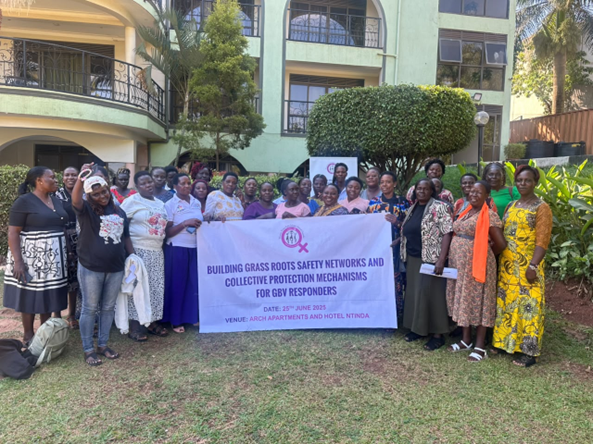
25 June 2026 | Arch Apartments and Hotel, Ntinda
For women working at the frontline of gender-based violence (GBV), supporting survivors can sometimes come at a personal cost. Responders may face intimidation, threats, stigma and violence simply for speaking up for another woman.
On 25 June 2026, the Women Human Rights Defenders Network Uganda (WHRDN-U) brought together 30 GBV responders from different parts of Uganda for a one-day training focused on building grassroots safety networks and collective protection mechanisms. The engagement also introduced participants to WHRDN-U and its work to protect and support women human rights defenders.
Understanding the Risks
The meeting created space for participants to share experiences and reflect on the risks associated with GBV response and advocacy.
Juliet from Palisa spoke about facing intimidation from members of her own family after defending her brother’s widow, who was at risk of losing her marital home.
Biira from Kasese shared how she was threatened after advocating for a 14-year-old girl with a disability who had become pregnant. Anna from Tororo also described being evicted from her home after supporting a tenant experiencing sexual harassment.
Their experiences highlighted that GBV responders can face hostility not only from perpetrators, but also from family and community members who view their advocacy as interference.

When Protection Comes at a Cost
Paulina, a woman human rights defender from Amudat, shared one of the most powerful testimonies of the day.
An advocate against child marriage and female genital mutilation (FGM), Paulina said members of her community killed her cattle after she provided shelter to girls who had escaped FGM and forced child marriage.
The loss affected both her livelihood and her ability to continue supporting the girls.
“The Network supported me with one cow after the community ganged against me and killed all my cattle because I was protecting girls who had run away from FGM and child marriage.”
The cow has since produced two more, helping her rebuild her livelihood.
“I am very grateful to the Network because that support helped me rebuild my livelihood while continuing my work.”

Her experience demonstrated that protection for human rights defenders can sometimes require more than responding to immediate threats. It can also mean helping defenders recover from retaliation so they can continue their work.
Building Protection Together
Participants explored practical ways of supporting survivors and responding to threats against defenders, including referrals, counselling, case management and connections to relevant protection services.
The discussions also emphasised the importance of both online and offline security, self-care and collective care.

For many participants, one of the most valuable outcomes was the opportunity to connect with other women doing similar work. Several described leaving with a new “sister” they could remain connected to and support beyond the training.
This sense of connection is central to the grassroots safety networks WHRDN-U is seeking to strengthen networks where defenders can share information, make referrals and respond collectively when someone faces a threat.
Continuing the Work
WHRDN-U will continue engaging the responders through mentorship, regional meetings and networking opportunities, while a follow-up training will focus on mapping community support structures, strengthening referral pathways and developing collective protection mechanisms.
Participants committed to continuing their GBV response work, documenting violations, maintaining communication with fellow defenders and referring other defenders to WHRDN-U where support is needed. Two cases involving threats and violations against women defenders from Palisa and Kasese were also documented during the engagement.
The meeting marked an important first step in connecting grassroots GBV responders to a wider protection network.
Because the women who stand up for survivors should not have to stand alone.