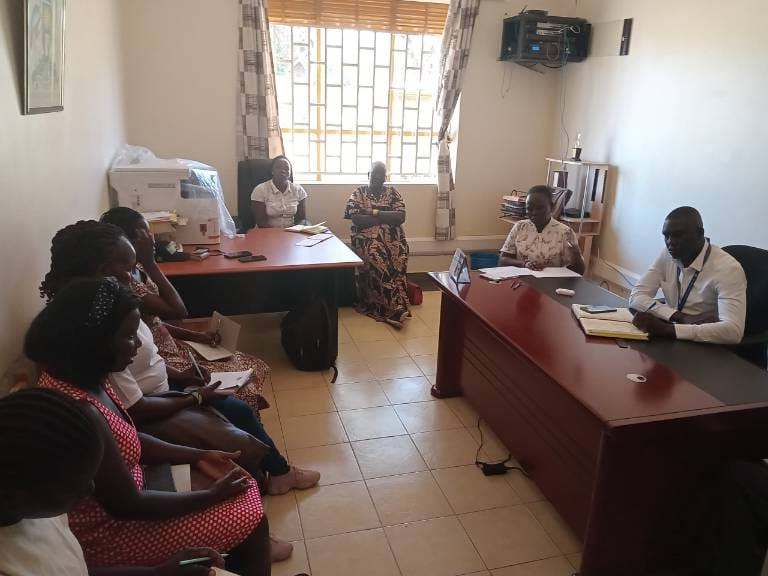
Over the period, we witnessed continued regional efforts by women human rights defenders to strengthen collective care, protection and joint action. Across different regions, defenders came together to support one another, share experiences, respond to protection concerns and engage duty bearers on issues affecting their communities. These actions demonstrated the importance of regional solidarity in helping women human rights defenders remain connected, protected and able to continue their work at grassroots level.
West Nile: Defenders Supporting One Another
In West Nile, women human rights defenders strengthened solidarity through visits, peer support and sharing of experiences. Following the meeting in Yumbe on 7 September 2026, defenders from different backgrounds visited Angella Apolot, a woman human rights defender with a disability who works with women in Driwala Market in Arua.
Lydia Endraa, a defender for structurally silenced defenders from Arua, Stella Biryema, a GBV activist from Zombo, and Peace Piracel, an environmental defender from Zombo, visited Angella in her community. The visit demonstrated that collective protection is also about checking on one another, learning from each other and creating connections that help defenders feel supported in their work.


The defenders also shared practical experiences of working with communities and duty bearers. Angella shared how she works with police, health workers, local council leaders and Village Health Teams to refer cases, follow up on violations and support community members to access services. The visit also created an opportunity to connect women who had previously been excluded from community initiatives, including a woman with a disability who is a sex worker and who was connected to Angella’s savings group.
The visit showed that solidarity goes beyond talking about support. It involves visiting one another, learning from each other and creating opportunities for women who may have been excluded to participate in community initiatives.


Eastern Region: Defenders Take Collective Action on FGM
In the Eastern region, on Monday, 21 September 2026 WHRDs from different districts came together at the Uganda Human Rights Commission regional offices in Moroto to raise concerns about Female Genital Mutilation and the risks faced by defenders challenging harmful practices.The collective action brought together defenders working on FGM, environmental rights, Indigenous peoples’ rights, sex workers’ rights, GBV and journalism. By coming together, the defenders were able to share their experiences and discuss the different risks they face in their communities.


A key concern was the safety and confidentiality of people who report serious cases, including rape, defilement and early marriage. Defenders shared concerns that the identity of complainants is not always kept confidential, which can expose both survivors and defenders to threats and possible attacks. They therefore discussed the importance of protecting the identities of people who report sensitive cases.
The engagement also strengthened the relationship between regional defenders and the Uganda Human Rights Commission. UHRC encouraged defenders to properly document cases and maintain communication with its regional offices so that emerging concerns from communities can be followed up.This collective action demonstrated how regional defenders can come together to raise protection concerns, share information and engage institutions jointly, while strengthening the support they need to continue their work.
Indigenous Women Human Rights Defenders: Standing Together Across Communities
Indigenous women human rights defenders from the Benet, IK, Batwa and Pokot communities also strengthened their collective action after recognising that, despite coming from different regions, they face similar challenges, including discrimination, marginalisation and struggles over ancestral land.The women recognised that they did not have to continue working in isolation. They informally formed the Indigenous Peoples Women Human Rights Defenders Initiative within the Women Human Rights Defenders Network Uganda. The initiative provides a space for them to come together, discuss issues affecting them, develop protection strategies and find ways of engaging institutions such as the Uganda Wildlife Authority.


One of their commitments was to visit the Batwa women human rights defenders in Bundibugyo and support them to strengthen their activism and organise their work. On 7 August 2026, 17 Indigenous women human rights defenders travelled from different communities to Bundibugyo to stand in solidarity with the Batwa community.


The women jointly commemorated the International Day of the World’s Indigenous Peoples and engaged the Uganda Wildlife Authority on issues affecting Indigenous communities. They raised concerns around the preservation of traditional knowledge and opportunities for Batwa communities to benefit from tourism and conservation.
The action demonstrated that collective care can translate into practical solidarity. Defenders travelled across regions to support one another, created a platform for joint action and engaged institutions together. Through these regional efforts, women human rights defenders are strengthening their collective voice, protection and ability to continue their work in their communities.
Published by Brenda Kugonza
Executive Director